
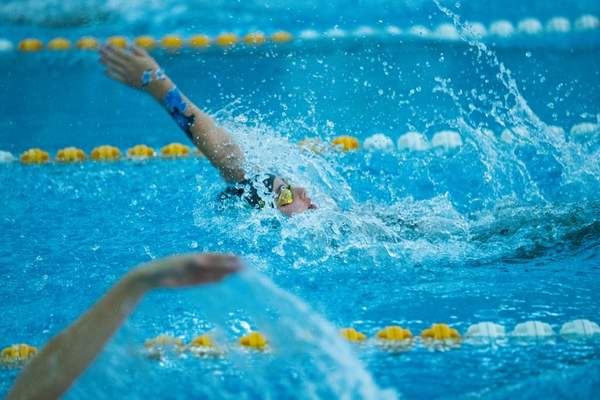
A swimmer who looks unstoppable in a 25-yard pool can feel surprisingly different halfway down a 50-meter lane. That is the practical difference behind short course vs long course swimming: the race isn’t simply stretched out. The number of walls, the distance between them, and the way swimmers hold their speed all change. For U.S. athletes moving from the school-year season into summer competition, understanding those changes makes results easier to interpret and training easier to plan.
Pool Length: The Basic Difference
Short course swimming takes place in a 25-yard or 25-meter pool, while long course swimming uses a 50-meter pool. In the United States, 25-yard pools are especially common for high school, college, and many club meets. Olympic pool races are contested in 50-meter pools.
SCY, SCM, and LCM Explained
SCY means short course yards: one length is 25 yards, or 22.86 meters. SCM means short course meters: one length is 25 meters. LCM means long course meters: one length is 50 meters. These are three distinct competition formats, with separate times and records. A 100-yard freestyle in SCY covers less distance than a 100-meter freestyle in LCM, so the times are not directly comparable even before considering turns.
More Walls Mean More Turns
Walls are opportunities to generate speed. During a strong flip turn, the swimmer rotates efficiently, pushes off in a streamlined position, and carries momentum into the next length. In a short pool, those moments happen more often.
Compare a 100-meter race in SCM and LCM. In a 25-meter pool, the swimmer covers four lengths and makes three turns. In a 50-meter pool, the same race covers two lengths and requires just one turn. A 200-meter event involves seven turns in SCM but only three in LCM.
That makes flip-turn technique a particularly useful area to revisit before short course season. However, more turns are not automatically better: a slow approach, poor push-off, or mistimed breakout can erase the advantage.
How the Race Rhythm Changes
Short course races can feel like a repeating sequence of acceleration, underwater travel, breakout, and a relatively brief stretch of surface swimming. There is little time to settle before the next wall arrives. Long course swimming gives swimmers a longer uninterrupted section in which stroke efficiency and pacing become more visible.
Starts, Underwaters, and Breakouts
The start matters in both formats, but its contribution is different when the course length changes. Short course athletes have more opportunities to use their underwater skills after turns. In long course, they must preserve momentum through substantially longer stretches between walls. Efficient underwaters still matter; they simply occur less often per 100 meters.
In a 50-meter long course freestyle, there is no turn to provide a second burst of speed. In a 50-yard short course freestyle, one turn divides the event. A swimmer who races both needs to know when to build speed without relying on an approaching wall.
Why Short Course and Long Course Times Differ
Swimmers often post faster times in short course races, especially when they have powerful turns and streamlined push-offs. But comparing SCY vs LCM times requires two separate corrections in your thinking: yards and meters are different distances, and the wall count is different. A 100-yard event is 91.44 meters, not 100 meters.
Even SCM and LCM results, which can cover the same total distance, are shaped by different turn opportunities. Stroke, event length, individual technique, and conditioning all affect the gap. There is no universal number of seconds that everyone gains or loses between formats.
What About Time Conversions?
Conversion calculators can estimate a swimmer’s likely performance in another course, and meet entry procedures sometimes use converted seed times. Treat them as estimates rather than personal records. A swimmer with strong underwaters may convert differently from one whose strength is steady surface speed. For meaningful progress tracking, keep separate best-time lists for SCY, SCM, and LCM, and compare each result with earlier swims in the same format.
A useful companion is how to read swimming meet times, especially when reviewing qualifying standards that specify yards or meters.
Moving From Short Course Season to Long Course
Many U.S. teams race short course during fall and winter, then shift toward long course competition in spring and summer, although calendars vary. The early long course meets can be humbling. Athletes accustomed to a wall every 25 yards may discover that the final 15 meters of a long pool demand more sustained technique than expected.
A Practical Training Adjustment
Imagine a swimmer who excels at 100-yard freestyle because the three turns are consistently sharp. Before a 100-meter long course meet, the swimmer can rehearse 50-meter repeats that emphasize holding stroke length and breathing rhythm through the middle of the pool. A coach might also time the second 25 meters of each repeat to see whether form deteriorates away from the wall. The goal is not to abandon turn practice but to develop speed that survives between turns.
Another helpful adjustment is to judge pacing by effort and stroke quality, not just by a familiar short course split. If long course access is limited, longer continuous swimming segments and controlled pace sets in a shorter pool can support endurance, though they cannot perfectly reproduce a 50-meter racing lane. For more ideas, explore freestyle pacing drills.
Which Format Is Harder?
Neither format is inherently harder for every athlete. Short course rewards precision at repeated turns, transitions, and breakouts. Long course exposes weaknesses in sustained speed, stroke mechanics, and pacing. Rather than labeling one course superior, ask which skills each format reveals and develops.
Frequently Asked Questions
Is short course swimming always 25 yards?
No. Short course can mean 25 yards (SCY) or 25 meters (SCM). The U.S. commonly uses yards, while many international short course meets use meters. Always check the meet’s course designation.
Why are long course swimming times usually slower?
For equal distances in meters, long course generally offers fewer wall push-offs, which can reduce opportunities for fast underwater travel. For SCY versus LCM, the longer race distance also affects the clock. Individual results vary.
Can I compare my SCY personal best with my LCM best?
You can use a conversion as a rough guide, but it is not an exact comparison. Track official personal bests separately for each course, and evaluate trends within the same format.
Are Olympic swimming events short course or long course?
Olympic pool swimming takes place in 50-meter long course pools. Separate international championships also feature short course meters racing in 25-meter pools.
Final Thoughts
The clearest way to understand short course vs long course swimming is to look beyond pool length. Short course offers frequent walls and repeated chances to accelerate; long course asks swimmers to maintain quality through longer uninterrupted stretches. Both formats reward skill, just in different proportions. When the season changes, expect your splits to change too—and use that difference to identify what to work on next.