
A promising attack stops, the referee raises an arm, and the commentator says “offside”. But where was the line, and who crossed it? Rugby offside rules confuse new fans because the answer changes with the situation: a pass, a kick, a ruck or a set piece. The starting point is simple. Players must not gain an unfair advantage by getting ahead of the play.
What Does Offside Mean in Rugby?
In rugby union, a player is generally offside in open play when positioned ahead of a team-mate carrying the ball or the team-mate who last played it. Being offside does not automatically bring a whistle. The player must avoid interfering with opponents, playing the ball or advancing towards it until legally put onside.
Think of the rugby offside line as an invisible boundary that moves. In open play, it relates to the ball and the last player to play it. At a ruck, scrum, maul or lineout, special boundaries apply. That difference explains many decisions that initially seem inconsistent.
Offside in Open Play: Watch the Ball Carrier
Imagine a centre running towards the opposition’s try line. A winger sprints ahead, hoping for a pass. If the centre passes backwards to another player, the winger may still be ahead of the team-mate who last played the ball. That winger cannot legally tackle a defender or interfere from that position.
Offside From Kicks: Why the Chasers Matter
Offside from kicks is particularly easy to spot on replays. When a player kicks, team-mates in front of the kicking foot are offside. They cannot immediately race forward to challenge the receiver. Chasers who started behind the kicker are onside and can compete, subject to the other laws.
How a player becomes onside again
An offside player may retreat behind the kicker or another onside team-mate, or be overtaken by an onside team-mate moving forward. In ordinary open play, an opponent’s kick or intentional touch can also put a player onside. One major exception catches out many spectators.
The special 10-metre law
An offside player near where a team-mate’s kick will land or be caught must immediately retreat behind an onside team-mate or at least 10 metres towards their own try line from that location. An opponent receiving or touching the kick does not cancel this particular obligation. A charge-down is different.
Picture a high kick dropping beside a defender. An attacker who started ahead of the kicker cannot simply wait next to the defender and claim to be onside when the catch happens. That explains a penalty even when no tackle occurs.
Offside at a Ruck: Find the Hindmost Player
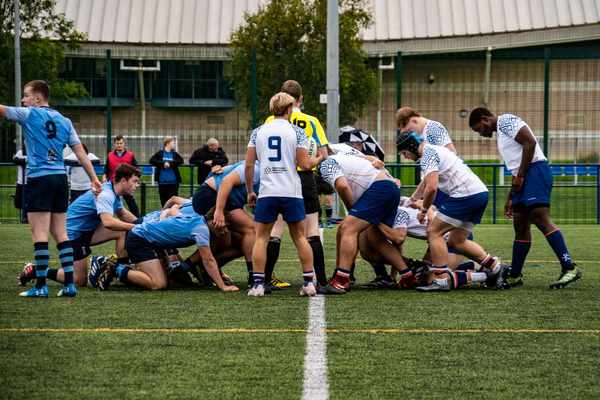
An offside at ruck decision depends on the position of players around the breakdown. Once a ruck forms, each team has a rugby offside line running across the pitch through the hindmost point of its own ruck participants. Other players must remain behind it or join legally from their own side.
Suppose defenders wait for a pass from the scrum-half. A defender who steps in front of the back of their team’s ruck before it ends can be penalised, even if the ball looks ready to leave. Watch the last player’s position rather than the scrum-half’s shoulders.
Someone offside at a ruck does not automatically become onside when it ends. They may need to retreat promptly; specific opposition actions, including carrying the ball five metres or kicking, can also put them onside.
Offside at a Scrum: Why Defenders Stand Back
At a scrum, players not taking part must generally stand at least five metres behind the hindmost foot of their own team’s scrum. This leaves space for attacking backs. If that hindmost foot is close to or behind a team’s try line, the offside line for non-participants is the try line.
Scrum-halves have their own positioning restrictions because they work near the scrum. The non-possessing scrum-half must follow specific options for remaining nearby or retreating. Scrum offside lines disappear when the scrum ends, not merely when the ball appears near the back.
Offside at a Lineout: Two Different Groups
Separate the players participating in the lineout from the backs outside it. Participants have offside rules linked first to the mark of touch and then, once the thrown ball has touched a player or the ground, to the ball. They cannot freely cross into the opposition’s space.
Non-participating players normally start at least 10 metres back from the mark of touch, unless their try line is nearer. After the throw, movement forward can be allowed, although players may need to retreat if the ball stays within the lineout area. If a ruck or maul develops, its offside lines become relevant.
What About Offside at a Maul?
In a maul, players remain on their feet around a ball carrier. Each team’s line passes through its hindmost participant’s foot nearest its own try line. Arriving players must join from an onside position and bind legally. Running around the side to join ahead of that line can bring a penalty.
Why Referees Sometimes Play On
The rugby offside law distinguishes an offside position from an offence. Officials may allow play to continue if the player does not interfere. Accidental offside, when someone cannot avoid contact with the ball or a ball-carrying team-mate, normally results in a scrum only when that team gains an advantage.
For open-play offside offences, the opposition can choose a penalty at the infringement or a scrum where the offending team last played the ball. Offside at rucks and set pieces generally means a penalty. Referees may also play advantage, so the whistle can come later.
How to Read the Next Offside Call
Start by identifying the phase. For a kick, locate the kicker and chasers. For a ruck or maul, find the hindmost participant. At a scrum, check the backs’ five-metre gap; at a lineout, distinguish participants from other players. This quick check tells you more than simply following the ball. For more context, explore rugby ruck rules and rugby scrum rules.
Frequently Asked Questions
Is standing in front of the ball always offside?
No. In open play, the relevant position is ahead of the team-mate carrying or last playing the ball. An offside player is not automatically penalised merely for being there, but must avoid prohibited involvement.
Can an opponent put an offside player onside?
Sometimes. An opponent’s kick or intentional touch can do so in ordinary open play. The 10-metre kick rule is an exception, so a receiver’s touch does not automatically clear nearby chasers.
How far back must defenders stand at a ruck?
There is no fixed five- or ten-metre gap. They must stay behind the line through the hindmost point of their team’s ruck participants.
Are rugby and football offside rules the same?
No. Rugby union uses the last player to play the ball and special lines for different phases. Football applies a different test involving attackers, opponents and the ball.
The Rule to Remember
When a call seems mysterious, look for the last player who played the ball or the back of the relevant set piece. Then ask whether someone crossed that invisible boundary and affected play. Once you notice those details, rugby’s stoppages become much easier to understand.