Ice hockey looks chaotic when everyone chases a loose puck, but the movement has a pattern. Each player has responsibilities that help the team attack, defend and stay organised. Once you recognise those jobs, a fast shift becomes much easier to follow.
How Many Positions Are There in Ice Hockey?
At normal full strength, each team has five skaters and a goaltender on the ice. The skaters are a center, left winger, right winger, left defenseman and right defenseman. The center and wingers are forwards, while the defensemen form a pair behind them.
People call this five-on-five because the count refers to skaters, not goalies. There are six traditional on-ice roles, although line changes, penalties and tactical choices can alter who occupies them.
Where Do Hockey Players Position Themselves?
Two blue lines divide the rink into three zones. Your team’s defensive zone contains its goal; the offensive zone contains the opponent’s net; and the neutral zone sits between them. Players usually begin in areas linked to their position, but they cross those boundaries constantly.
When a team attacks, forwards generally push ahead and defensemen support from behind. When possession turns over, everyone must defend. The center may retreat toward the net, a winger may cover a passing lane and a defenseman may challenge the puck carrier before a shot develops.
The guide to ice hockey rules for beginners is a useful companion for understanding the blue lines, faceoffs and offside calls that shape these movements.
Forward Positions: Center and Wingers
Center (C): The Two-Way Connector
Centers often take faceoffs, support the puck through the middle and connect defense to attack. A center might collect a pass in neutral ice, feed a winger breaking wide and then skate toward the net for a rebound.
Without the puck, the center usually helps defend the middle and supports defensemen near the goal. Good skating, awareness and quick decisions matter because the position involves repeated transitions. Other players can take faceoffs, though centers normally handle many of them.
Left Winger (LW): Width, Pressure and Chances
The left winger commonly starts on the left side of the attacking direction. That player receives passes along the boards, pursues loose pucks and creates chances with shots or passes. On defense, the winger often watches the opposing defenseman on that side while helping protect passing lanes.
Right Winger (RW): Attacking From the Other Flank
The right winger has similar duties on the opposite side. A typical move is to carry the puck wide, draw a defender and pass toward a teammate moving into open ice. Right wingers also forecheck, backcheck and help move the puck out of their own zone.
Left wing and right wing describe a player’s usual side, not shooting handedness. Coaches sometimes deploy players on their opposite shooting side to create different angles.
Defensemen: Protecting the Net and Moving the Puck
Left and Right Defensemen (LD and RD)
Defensemen try to prevent clear scoring chances. They maintain space between attackers and their own goal, challenge entries into the defensive zone, retrieve pucks and help protect the area in front of the goalie. The left and right labels describe their usual sides, although partners shift their coverage during play.
These hockey player roles extend well beyond stopping shots. A defenseman who wins the puck may send an outlet pass to a winger or carry it forward. In the offensive zone, defensemen often patrol near the blue line to keep possession alive, distribute passes and shoot when an opening appears.
A reliable pair communicates about who pressures an attacker and who protects the space behind. If both chase the same puck carrier, an opponent can become dangerously open.
Goaltender (G): The Last Line of Defense
The goalie role centres on preventing goals, but it involves more than reacting to shots. Goaltenders position themselves to reduce shooting angles, move across the crease to track passes and control rebounds so opponents do not get an easy second attempt.
Goalies also communicate with defensemen and may handle the puck to help a breakout. They wear specialised equipment and operate under rules different from those for skaters. Their main workplace is the crease and nearby ice, not a fixed point on the goal line.
How the Positions Work Together: A Breakout Example
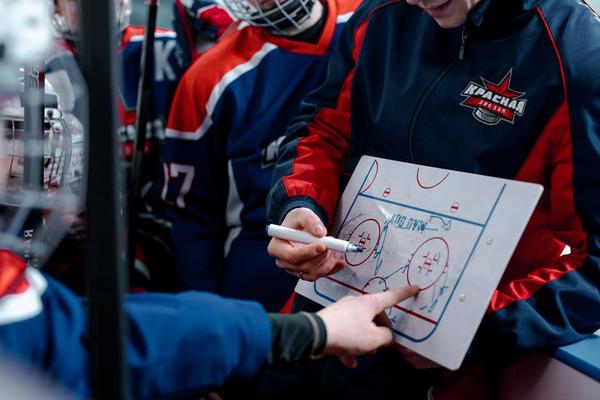
Imagine a defenseman recovering the puck behind their own net. The center skates low to offer a short pass. The left winger moves toward the boards, and the right winger finds open space farther up the rink. The defenseman passes to the left winger, who advances through neutral ice and finds the center. As the center carries the puck forward, the right winger heads toward the net to create a passing target.
The defensemen follow at a controlled distance, ready to support possession or stop a counterattack. Notice that even players without the puck contribute by creating passing angles or covering open space. That is the easiest way to see the teamwork behind a scoring opportunity.
How Penalties and Line Changes Affect Positions
During a power play, one team has more skaters because an opponent is serving a penalty. Coaches may use extra attacking forwards or assign a defenseman a different position in their setup. The shorthanded team adapts to protect dangerous areas with fewer players.
Teams also rotate forward lines and defensive pairs during short shifts. Late in a close game, a trailing team can replace its goaltender with an extra skater. The familiar three-forward, two-defenseman arrangement is therefore a starting point, not a universal rule for every moment.
A Viewing Tip for New Fans
During one shift, follow the center rather than the puck. Look for how often the center offers support in all three zones. On the next shift, watch a defenseman manage space before an opponent shoots. The guide to hockey faceoff rules can help explain where each sequence begins.
Frequently Asked Questions
What is the most important position in ice hockey?
No single position wins games alone. The goalie stops shots, forwards create attacking chances and defensemen help protect the net and launch plays. Successful teams need all of those contributions.
Is center harder than winger?
Centers often cover more defensive responsibilities and take faceoffs, which can be demanding. Wingers face their own challenges along the boards and when finding scoring space. The best fit depends on a player’s strengths.
Can defensemen score goals?
Yes. Defensemen can shoot from the blue line or join an attack. The important trade-off is making sure teammates cover the space left behind if possession changes.
Do players stay in their assigned position?
No. They have usual roles, but move and exchange coverage as the play develops. Coaches can also change assignments for penalties, line combinations or specific tactics.
Putting the Roles Together
The center links both ends of the rink, wingers create width and pressure, defensemen protect dangerous space and start attacks, and the goaltender guards the net. Learn those basic responsibilities first. Soon, instead of seeing a crowd chasing the puck, you will see players working together to control the game.